


When managing the flow of water, every drop counts. Too much rain can impact lakes and rivers; too little can threaten the region’s drinking supply and disrupt power generation.
Achieving balance ahead of a major storm or flash flood involves multiple factors, including weather forecasting. Duke Energy has an advanced in-house meteorology team that continuously monitors weather conditions.
The Catawba-Wateree hydro project is Duke Energy’s largest developed river basin, encompassing 12 hydro stations and 11 lakes across more than 225 miles in North Carolina and South Carolina.
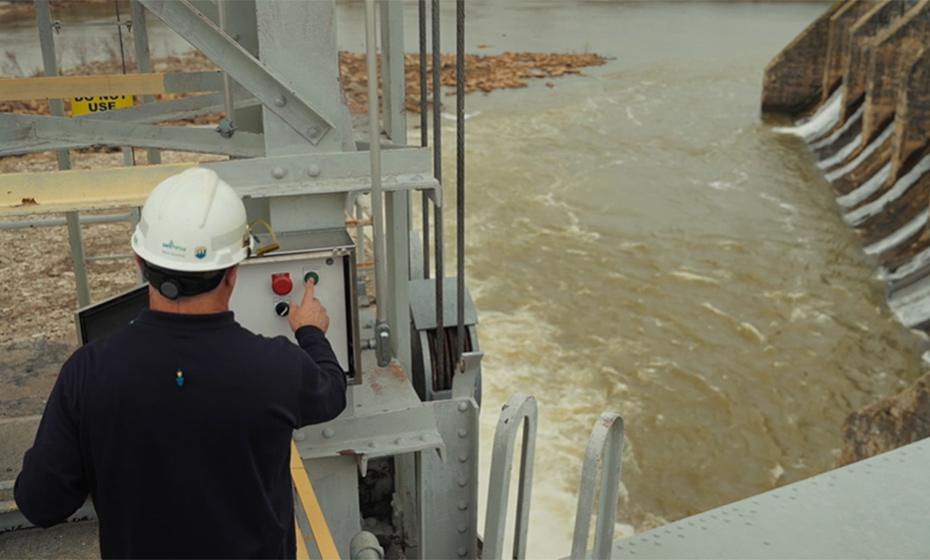
The project was constructed a century ago to power the area’s emerging textile industry – and, while some lakes in the Carolinas were built for flood management, Duke Energy’s lakes were designed and licensed as a power generation project that also provides benefits such as recreation, marine life habitats and drinking water for millions in the region.
Managing reservoirs as an interconnected system
The Catawba-Wateree project is managed as an interconnected system rather than as individual lakes.
Flow releases from one lake impacts water levels of others downstream, making dam integrity crucial in all decisions to move water. Decisions to move water are based on electricity demand, weather, habitat protection, and public recreation access, including boating and camping.
You might think of the basin’s largest lakes – Lake Norman and Lake James in North Carolina, and Lake Wateree and Lake Wylie in South Carolina – as bathtubs. These “tubs” accommodate most of the system’s capacity to store water; other, smaller lakes along the Catawba-Wateree River like Mountain Island or Lookout Shoals, are small buckets by comparison.
When preparing for a storm, Duke Energy evaluates the entire lake system before moving water. Normal water flow is managed through each station's powerhouse. If the inflow exceeds the powerhouse capacity during storms, overflow spillways are used at some lakes to help pass excess water; other lakes, such as Lake Norman, have gated spillways, or floodgates, that are raised.
The company’s hydro fleet is managed and operated remotely from a central hub in Charlotte, N.C., known as the Regulated Renewable Operations Center (RROC). The decision to centralize operations in 2000 allowed for greater efficiency and quicker response to changing weather conditions and demand for electricity.
The RROC team relies on numerous weather models to forecast inflow from an approaching storm and proactively moves water to maximize lake storage. This advanced forecasting system considers dozens of factors, starting with meteorological forecasting, before potential high-water events.

“Each model drives different impacts, decisions and results,” said RROC Director Aaron Dale. “There are dozens if not hundreds of forecasts available, and we’re looking at the bulk of the models in order to take everything into account.”
Dale said meteorologists and hydro operators primarily use the Global Forecast System (GFS) and the European Centre for Median-Renate Weather Forecasts (the “European” model).
“When watching the news, meteorologists provide a general weather forecast. For instance, predicting 3 inches of rain is broad compared to the RROC’s detailed and precise modeling,” he said.
"The timing and location of rainfall significantly impact water management. Three inches over three hours versus 24 hours and even a small distance can alter inflow, affecting how the RROC prepares and manages water. Rain hitting one side of a sidewalk could end up in one reservoir, while the other side could direct it to a different one."
Hydro fast facts
Each hydro generating station consists of three major components to create electricity: a dam, a powerhouse and a spillway.
- The dam’s role is to create lakes.
- Based on customer demand, Duke Energy can raise or lower lake levels to move water through a powerhouse’s spinning turbine and generate electricity.
- When heavy rain causes a lake to overflow, a spillway can pass excess water downstream while protecting the dam – essential for the safety of our communities. Spillways are instrumental in managing and mitigating flooding impacts.
Learn how Duke Energy manages reservoirs to keep power flowing.
The RROC also accounts for topography and saturation. In areas with mountainous terrain, like western North Carolina, gravity can lead to flash floods and place more strain on reservoirs compared to flatter areas of the Carolinas. Considering soil and moisture helps determine the amount of precipitation that will run off versus what the ground will absorb.
Of course, even the most extensive planning cannot thwart every scenario, given the weather’s ability to change without warning.
“We start talking about a truly actionable forecast about three days out,” Dale said. “That’s when you really start to see the weather models begin to converge. And even then, sometimes there are disparities.”
Due to forecasting variances, Duke Energy must balance lowering lake levels before a storm against the possibility of the storm shifting or missing the river basin altogether. If a storm shifts, it could result in an unintended drinking water shortage, especially if followed by a prolonged dry period. Additionally, the lakes supply water for industrial uses, power generation and recreational activities.
During a storm
When a storm occurs, Duke Energy teams adjust and make real-time decisions to efficiently manage the system. This involves ensuring the dams are structurally sound and that spillways operate as intended.
“Once the rain has hit the ground, we can better predict the extent that the lakes are going to spill or fill up,” said Chief Dam Safety Engineer Brad Keaton. “We don't know until all the water is on the ground how extensive the flooding is going to be.”
The utility’s hydro sites – including Cowans Ford in Huntersville, N.C., the company’s largest conventional hydro plant – are licensed by the Federal Energy Regulatory Commission (FERC). It requires Duke Energy to activate an emergency action plan during abnormally high flow releases, and to lower those lakes when it’s safe to do so.
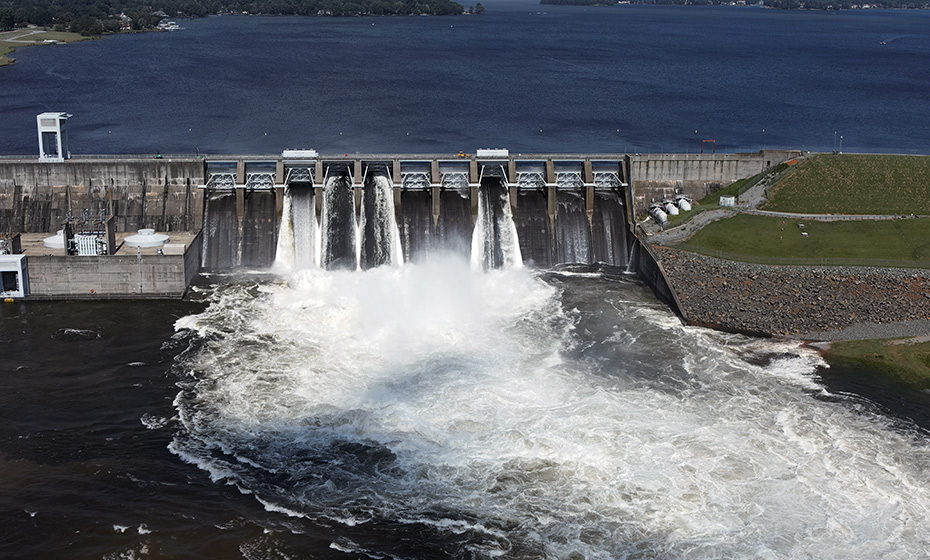
FERC also requires public safety plans that include details about signage and warning horns. Coordinating with emergency management partners is essential for notifying customers who might be at risk, as outlined in the action plan.
Keaton’s team trains and partners with emergency management officials year-round to prepare for any scenario – and are in constant communication during weather events. They host annual training sessions that focus on emergency action plans and routine inspections, and how they combine to preserve dam safety.
“We’re constantly working with county and state emergency management agencies,” he said, “running models to measure what could be the worst impact.”
County officials use this intelligence to determine whether to disconnect power and close roads or bridges. Duke Energy’s Lake View mobile app tracks real-time fluctuations in water levels, and texts customers with alerts. Find it on the App Store or on Google Play.
After a storm
In the immediate aftermath of a high-water event, Keaton’s team inspects the dams to evaluate their integrity. Field technicians use instrumentation monitoring to track structural safety and performance, then report those findings to Keaton’s staff for review. A calendar years’ worth of data is reported annually to the FERC and must prove that the dams and spillways are operating safely.
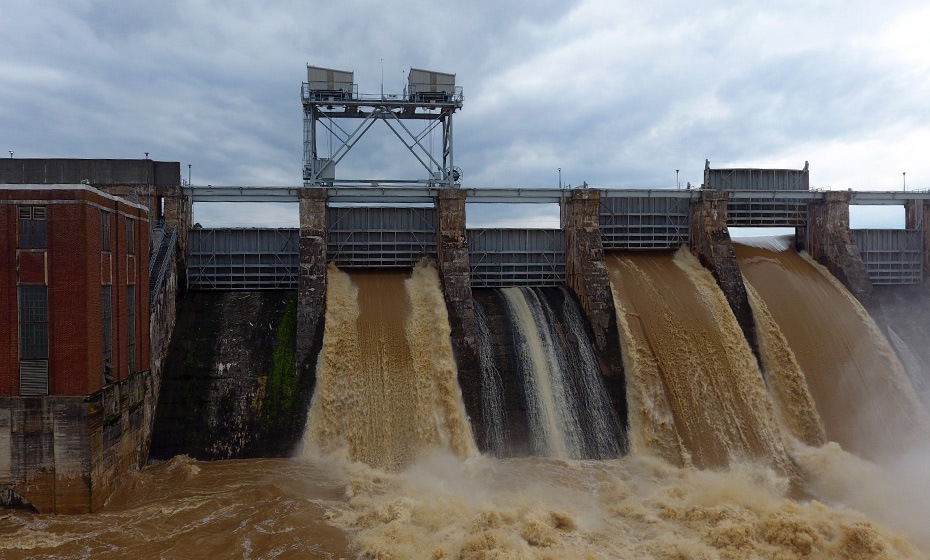
Keep in mind: it is possible for lake levels to remain higher than normal for several days following an event. Customers should wait for clearance from local emergency management officials before returning to the water for recreation.
In the meantime, the hydro operations team will move water through the system to return them to seasonal target levels. How long this takes depends on the storm's magnitude, Keaton said, and whether forecasting models predict rain within the next couple of weeks.
If the forecast is clear, the remaining flow is directed through powerhouses to lower the lake levels and optimize hydropower generation.
“Managing a system this large and this complex takes the highest level of coordination and data-driven decision-making,” he added. “I am extremely proud to be a part of a team that has this critical responsibility.”


